Removal Boxes Review: Which Type Works Best?
A practical removal boxes review covering sizes, strength, costs and common mistakes so you can pack properly and avoid breakages on moving day.
A rushed box choice usually shows up later as split bottoms, crushed corners or crockery wrapped in hope rather than protection. That is why a proper removal boxes review matters before you pack a single room. The right box does not just hold your belongings. It saves time, reduces damage and makes loading the van far more straightforward.
Most people buy boxes once every few years at most, so it is easy to assume all cardboard boxes are roughly the same. They are not. Strength, size, board grade, handles and how the box folds all affect how well it performs during a move. If you are packing a flat, family home or small office, choosing the wrong mix usually means wasted money at one end and avoidable hassle at the other.
Removal boxes review: what actually matters
The first thing to look at is not the label on the pack. It is the box structure. A decent removal box should feel firm before you fill it. If the cardboard bows too easily in your hands, it will struggle once books, kitchenware or files go inside. Double-walled boxes are usually the safer option for house moves because they cope better with stacking, lifting and transport.
Size matters just as much as strength. Large boxes look efficient, but they are often overfilled with heavy items and become awkward to carry. Small and medium boxes tend to work better for dense contents such as books, tools, documents and tins. Larger boxes are better for lighter bulkier items such as bedding, clothes and lampshades. A box that is technically strong can still be the wrong choice if it encourages poor packing.
Handles are another detail people overlook. Cut-out handles can make lifting easier, but only if the cardboard around them is reinforced. Weak handles tear under strain, especially if the box is packed too heavily. A plain box without handles can sometimes be more reliable than a badly designed handled one.
Then there is assembly. Boxes with awkward folds or poor-fitting flaps slow the whole job down. If you are packing under time pressure, simple construction helps. You want boxes that tape securely, sit square on the floor and stack neatly in a van or storage unit.
The main box types and where they work best
Standard small boxes are the workhorses of most moves. They are ideal for heavier household items because they keep the load manageable. If you are packing a kitchen, study or garage, these usually do most of the hard work. They also stack well because they are less likely to bulge.
Medium boxes are the most versatile. They suit toys, folded clothes, small appliances and general household contents. If someone wants one size for most rooms, this is often the safest middle ground. The trade-off is that people tend to use them for everything, including items that really belong in either a smaller or larger box.
Large boxes have their place, but they are often overused. They are useful for duvets, cushions, coats and lightweight soft furnishings. They are not ideal for books, plates or mixed heavy items. A large box filled with dense contents may look tidy, but it quickly becomes hard to lift safely.
Wardrobe boxes are convenient for short moves where speed matters. They keep hanging clothes crease-free and save time on the other side. They are more expensive than standard cartons, so they are best used selectively rather than for the entire wardrobe.
Specialist boxes for glassware, mirrors or televisions can be worthwhile if you are moving fragile or high-value items. They cost more, but so does replacing damaged goods. If you are moving once and packing valuable items, this is one area where cutting corners can backfire.
Cheap versus premium boxes
A sensible removal boxes review has to deal with price, because cheap packs are tempting. Lower-cost boxes can work for light items, short journeys and careful handling. If you are moving a few bags of linen from one local property to another, budget boxes may do the job.
The problem starts when cheap boxes are asked to do too much. Thin board, weak corners and low-quality folds tend to fail under stacking pressure or moisture from damp garages and sheds. That does not always mean they collapse dramatically. More often, they soften, warp or make carrying less secure.
Premium boxes are not automatically better value either. Some are simply better marketed. What you are paying for should be visible in the board thickness, clean folds, stronger base structure and better durability. If the box is going into storage, being moved over distance or holding fragile contents, paying more often makes sense. If it is just carrying spare bedding for a short local move, it may not.
Common packing mistakes that make good boxes fail
Even strong boxes perform badly when packed badly. Overloading is the biggest problem. If a box is difficult to lift from the floor before it leaves the room, it is too heavy. That puts strain on the base, the tape and the person carrying it.
Poor weight distribution is another issue. Heavy items should sit at the bottom with lighter items on top. Fragile items need proper wrapping and should not rattle about inside open space. A strong box is not a substitute for packing paper, bubble wrap or sensible arrangement.
Another mistake is under-taping. One strip along the base is not enough for heavier contents. The bottom should be sealed properly, especially on reused boxes where the original folds may already be weakened. Reused boxes can be fine, but only if they are clean, dry and still structurally sound.
Labelling helps more than people expect. Clear room names and handling notes make unloading faster and reduce rough handling. If every box says "misc", the job slows down and fragile items are more likely to end up under something heavier.
Are plastic crates better than cardboard?
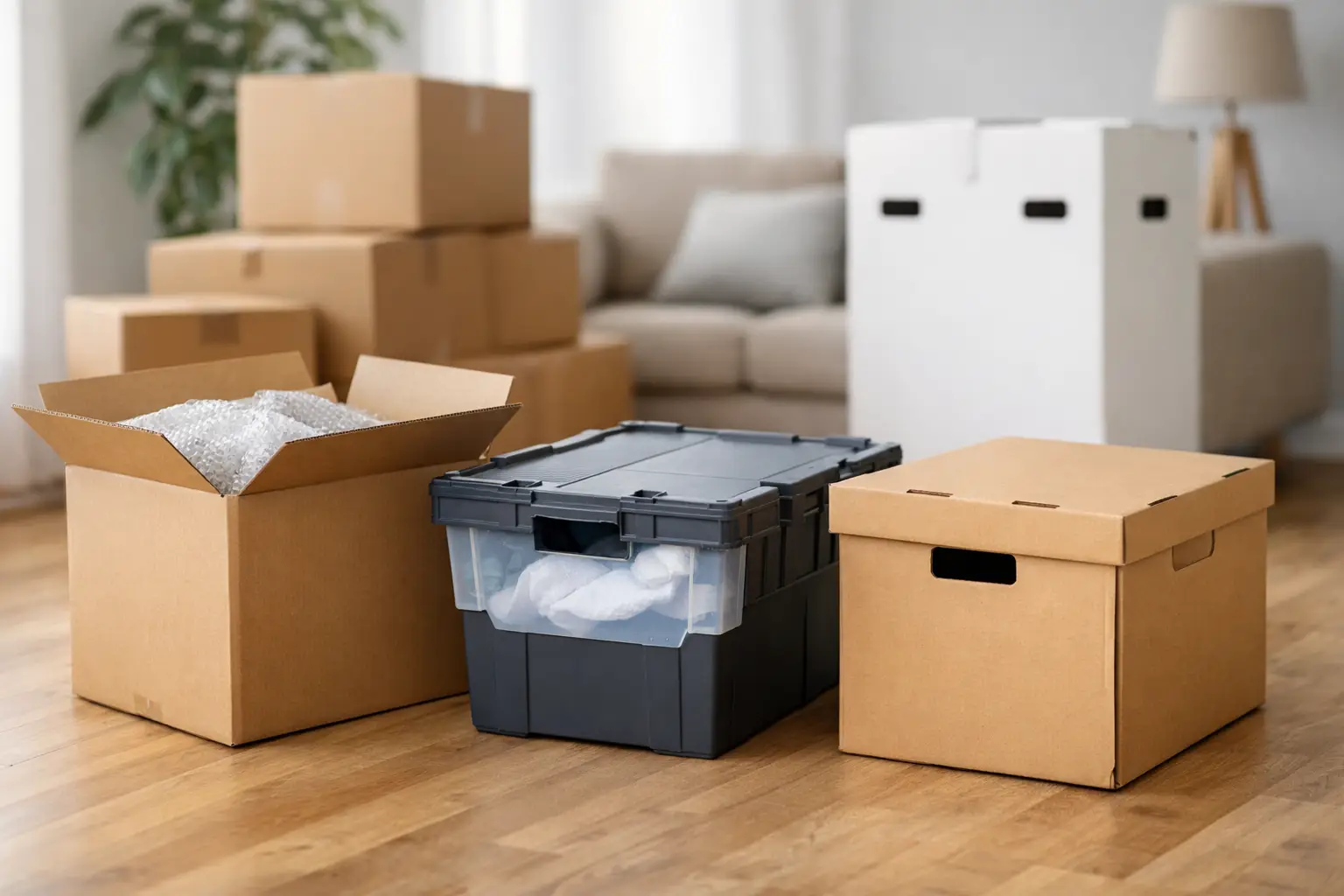
Sometimes, yes. Plastic moving crates are stronger, more weather-resistant and stack very well. For office moves, archive files, electronics or repeated transport, they can be the better option. They also save time because there is no assembly.
For most domestic moves, though, cardboard remains the practical choice. It is cheaper, easier to source in quantity and more flexible for mixed household contents. It also works better when you need to flatten and dispose of packing quickly after the move. Plastic crates are useful, but they are not automatically the right answer for every household.
How many boxes do you really need?
This depends on how you live rather than just the number of bedrooms. A two-bedroom flat with minimal furniture may need far fewer boxes than a one-bedroom property packed with books, kitchen kit and stored clothing. As a rough guide, people usually underestimate.
That is why a mixed bundle is often more practical than buying one size in bulk. Small boxes for heavy items, medium boxes for general packing and a few larger boxes for lighter contents gives you flexibility. If you are packing an office or doing a full family move, adding a few specialist boxes for monitors, files or hanging clothes can save time on moving day.
If you are using a removals team, ask what they see go wrong most often. In our experience, customers are usually short on small strong boxes and overstocked on large ones that cannot be filled properly without becoming too heavy.
What to look for before you buy
A useful removal boxes review should make buying simpler, not more technical. In practice, look for double-walled construction for general moving, especially for kitchens, books and storage items. Check the stated dimensions so you know what will actually fit. Read whether the pack includes tape or not, because some so-called value bundles do not. Make sure the box style suits your move rather than just the price point.
If you are moving on a deadline, convenience matters too. A slightly more expensive pack that arrives promptly and holds up properly can be better value than a cheaper one that needs replacing halfway through packing.
For larger home or office moves, getting packing support can be the smarter option. A professional team will usually bring the right materials, pack to a sensible weight and load the van efficiently. That reduces breakage and saves hours. For customers who want the job handled properly without guesswork, that is often the more economical route overall, even if it looks dearer at first glance.
A good box should do one simple job well - protect what is inside and move without fuss. If you choose boxes by weight, strength and what each room actually contains, you will pack faster, carry safer and arrive with fewer problems to sort out.
Get a free fixed written quote in 2 mins
Insurance up to £50,000 included · No cancellation fees · Free dismantling & reassembly

Our team of fully-insured removal specialists helps families across Slough, Windsor, Maidenhead and the wider Berkshire area move home every week. We pack, load, drive and unload boxes every day — every guide on this blog comes from real jobs, not theory.
Reviewed & fact-checked by Allah Nazar Ihsan — Founder & Managing Director, HomeGo Removals & Packing Ltd
Planning your move?
Get a free, no-obligation written quote from Berkshire's trusted independent removers. We're answering the phone right now — 24 hours a day, 7 days a week.