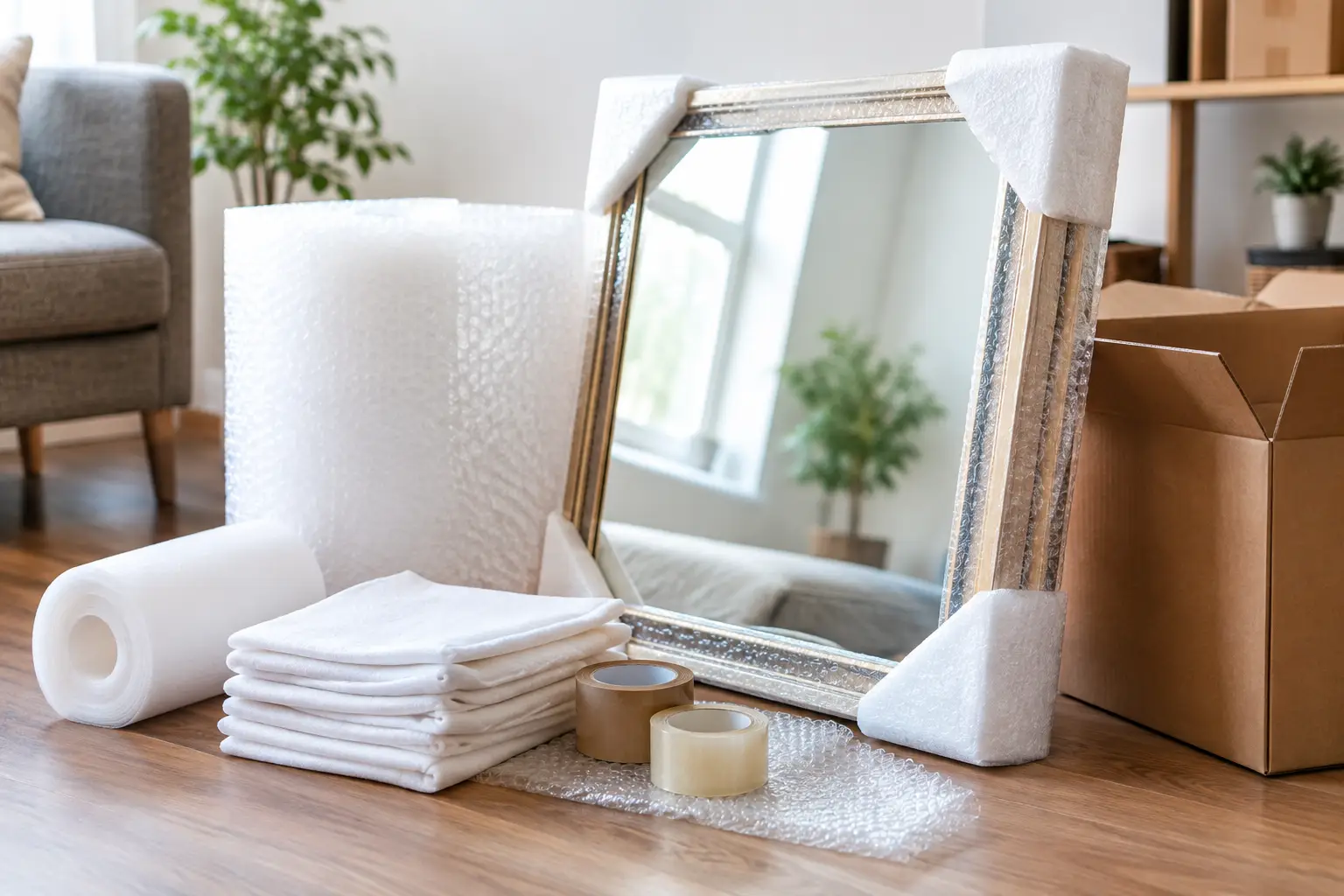
Best Packing Materials for Mirrors When Moving
Choose the best packing materials for mirrors to prevent cracks in transit. Learn the right wrapping order, box choice and when professional packing helps.
A mirror can look secure at the start of a move and still crack because it was packed with one weak layer, placed in the wrong box or left able to move inside the vehicle. The best packing materials for mirrors work as a system: they protect the glass face, support the frame and stop the item shifting from collection to delivery.
For a small framed mirror, careful DIY packing can work well. Large, antique, frameless or unusually shaped mirrors need more caution. Their weight, fragile edges and awkward size make them harder to lift safely, particularly on stairs or through narrow hallways.
Best packing materials for mirrors
Start with clean, dry materials. Dirt trapped beneath wrapping can scratch the glass or frame, while damp cardboard and paper can mark wood, fabric or backing boards.
The most useful materials are:
- Low-tack masking tape or painter's tape to make a light X across the glass. This can help hold fragments together if the glass breaks, but it does not make the mirror shatterproof.
- Acid-free tissue paper or packing paper for the first protective layer, especially around decorative frames and corners.
- Bubble wrap with medium or large bubbles for impact protection. Use more than one layer for a large mirror.
- Foam corner protectors or folded cardboard corners to protect the most vulnerable part of the frame.
- Double-wall cardboard mirror boxes or two flat pieces of heavy-duty cardboard, sized as closely as possible to the mirror.
- Strong packing tape and stretch wrap to secure the outer layers without placing adhesive directly on the frame or glass.
Avoid relying on a duvet, towel or blanket alone. These are useful as an outer moving blanket, but they compress under pressure and do not provide enough edge protection. Newspaper is also a poor first layer because ink can transfer, particularly in damp conditions.
Choose materials by mirror type
A standard wall mirror with a solid frame usually needs packing paper, bubble wrap, corner protectors and a sturdy box. A frameless mirror needs even more protection around the edges because there is no frame to absorb a knock.
For antique, gilded or carved frames, keep tape away from the finish and use soft paper first. Bubble wrap pressed straight onto delicate paint, leafing or raised decoration can leave impressions. If the mirror is exceptionally valuable, professionally packed transport is the safer option.
Prepare the mirror before wrapping
Take the mirror down carefully and remove any hanging wire, hooks or loose fittings where possible. Put small fittings into a labelled bag and keep it with the mirror or in a clearly marked essentials box. A loose bracket can scratch the glass during transit.
Check the frame for existing loose joints, chips or cracked glass. Taking a few photographs before packing gives you a clear record of its condition. If there is already a crack, do not attempt to move the mirror without extra support. Cover the face lightly with tape, wrap it fully and tell the removal team before lifting.
Clean the surface only if needed, then allow it to dry completely. A mirror packed while damp may develop marks or cause paper and cardboard to stick.
How to wrap a mirror securely
Lay a clean blanket or flattened cardboard sheet on a clear floor space. Do not pack a large mirror on a bed or soft sofa, where it can twist as you work. Ideally, have another person steady it.
First, place strips of low-tack tape diagonally across the glass to form an X. For a larger mirror, add a second X so the tape creates a simple grid. Do not use strong parcel tape, and do not stick tape directly to an ornate, painted or unfinished frame.
Next, cover the entire face with packing paper or tissue paper. Fold the paper over the frame edges, but do not pull it tight enough to put pressure on the glass. Add corner protectors, then wrap the mirror in bubble wrap. Keep the bubbles facing out where possible, with the smoother side against the paper-covered mirror.
Use two or three full layers of bubble wrap for most household mirrors. Secure each layer with tape around the wrapping, not onto the mirror itself. For heavy items, add a final layer of cardboard before placing it in a box.
Protect the edges, not just the front
Most breakages happen at the corners or edges after a bump against furniture, a door frame or another box. A well-wrapped front is not enough if the mirror can take a direct hit on one corner.
If you do not have purpose-made corner protectors, fold thick cardboard into L-shaped guards and tape them onto the outer wrapping. The cardboard should extend slightly beyond each corner, creating a small buffer zone.
Use the right box or cardboard sandwich
A purpose-made telescopic mirror box is the most secure choice because it keeps the mirror upright and protects both faces. Choose a box that is close to the mirror's size. A box that is much too large creates empty space, which allows movement and increases the chance of damage.
Where a mirror box is not available, make a cardboard sandwich. Place the fully wrapped mirror between two rigid sheets of double-wall cardboard, with the cardboard extending beyond every edge. Tape the sheets firmly together around the outside. Add another layer of bubble wrap or a moving blanket for transport.
Fill small gaps in a box with crumpled packing paper or foam. Do not force large amounts of loose material around the frame, as pressure points can damage the glass. Once sealed, label both sides clearly: FRAGILE - MIRROR - KEEP UPRIGHT.
Loading mirrors into the removal vehicle
Mirrors should travel upright on their long edge, never flat. Flat packing puts uneven pressure across the glass and makes it more vulnerable to vibration. Stand the mirror against a padded, solid surface and secure it so it cannot slide, topple or rub against other items.
Never put heavy boxes, furniture or appliances against a mirror. Keep it away from loose tools, bed frames and sharp-edged furniture. In a packed vehicle, the safest place is usually alongside a padded wall or in a protected gap between mattresses or other soft, stable items.
A large mirror should always be carried by two people. Lift from the sides rather than the top edge, keep it vertical and move slowly around tight corners. Gloves with grip can help, but they do not replace proper lifting technique or enough people for the job.
Common packing mistakes that cause mirror damage
The usual problem is not a lack of bubble wrap. It is using protection in the wrong order or assuming a mirror will stay still because it feels tightly wrapped.
Do not tape directly onto the glass with standard parcel tape. It can leave difficult residue and may pull at the backing or finish when removed. Do not use a bin bag as the main protective layer either. It prevents dust but offers no meaningful impact protection.
Another mistake is packing a mirror with only one cardboard sheet on the front. Both faces need support, and every corner needs a buffer. Finally, avoid carrying a mirror flat unless a specialist has advised otherwise. Even strong-looking glass can flex under its own weight.
When professional packing is worth it
Professional packing is particularly useful for oversized wall mirrors, mirrored wardrobes, antique pieces and items going into storage or travelling a long distance. The team can supply the correct materials, assess the safest lift and secure the item properly in the vehicle.
For customers moving across Berkshire, London or the surrounding counties, HomeGo Removals & Packing Ltd can pack and transport fragile household items as part of a fixed-price removal service. This is often the practical choice when the mirror is too large to box safely at home or the move is already time-sensitive.
A mirror is one of the last items you want to replace after moving day. Give it rigid edge protection, keep it upright and make sure it cannot move in transit. Those three steps do more to prevent damage than simply adding another roll of bubble wrap.
Get a free fixed written quote in 2 mins
Insurance up to £50,000 included · No cancellation fees · Free dismantling & reassembly

Our team of fully-insured removal specialists helps families across Slough, Windsor, Maidenhead and the wider Berkshire area move home every week. We pack, load, drive and unload boxes every day — every guide on this blog comes from real jobs, not theory.
Reviewed & fact-checked by Allah Nazar Ihsan — Founder & Managing Director, HomeGo Removals & Packing Ltd
Planning your move?
Get a free, no-obligation written quote from Berkshire's trusted independent removers. We're answering the phone right now — 24 hours a day, 7 days a week.