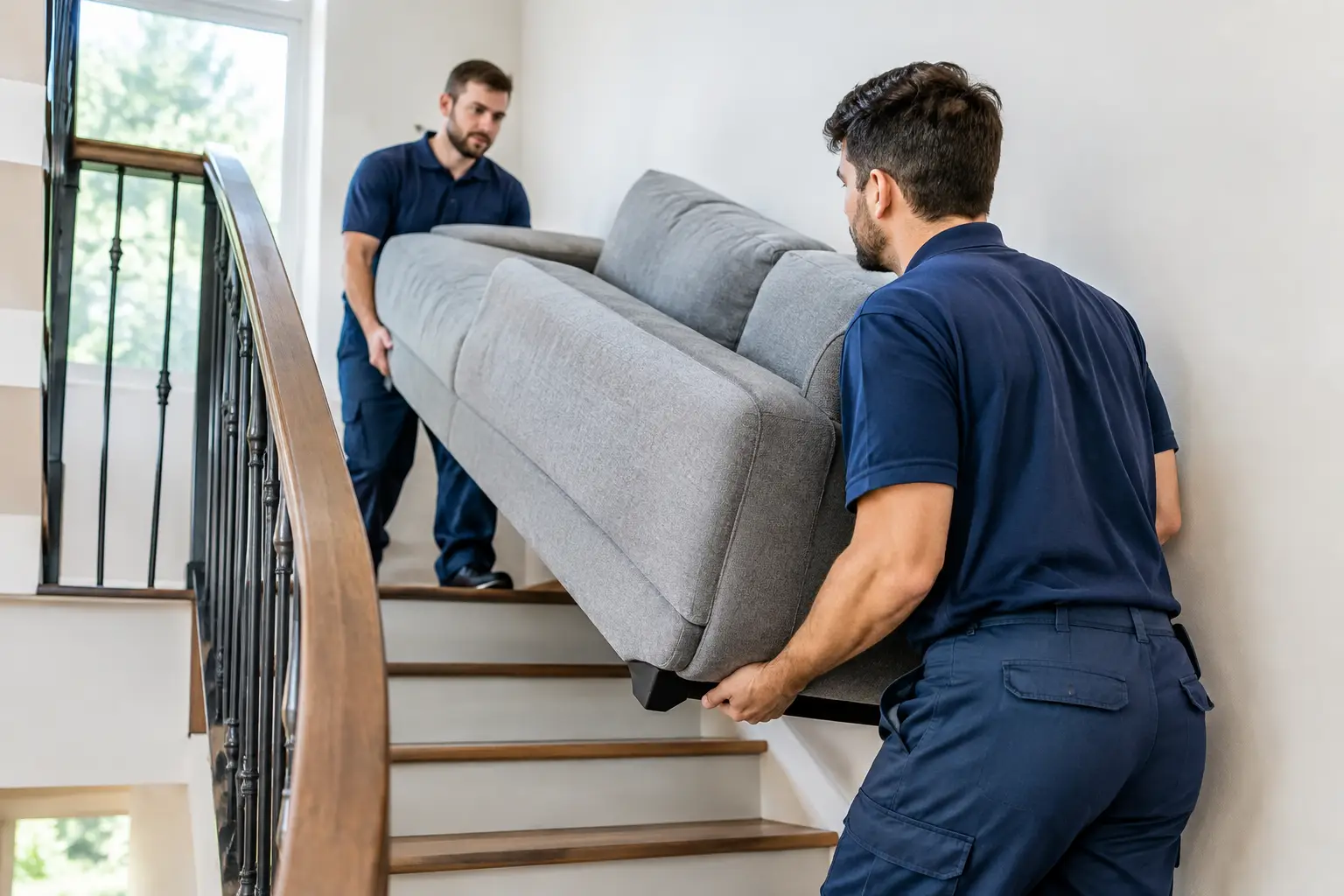
Can Movers Handle Stair Access? What to Know
Can movers handle stair access safely? Learn what removal teams assess, how stair moves are planned and what to tell your mover before moving day arrives.
A third-floor flat, a narrow Victorian staircase or a basement office does not automatically make a move difficult. Can movers handle stair access? In most cases, yes. Professional removal teams move furniture up and down stairs every day, but the right plan depends on the staircase, the items involved and the available access at both properties.
The key is to raise stair access when requesting your quote. Clear information helps your mover send the right team, vehicle and protective equipment, keeping the move safe, efficient and properly priced from the start.
Can movers handle stair access in flats and houses?
Yes, provided the stairs are safe to use and there is a practical route for each item. A trained team can carry boxes, white goods, sofas, beds, wardrobes and office furniture through multi-storey homes, converted flats and buildings without lifts. They will assess the weight of an item, the width and turns of the staircase, headroom, handrails and landing space before lifting.
Stairs do add time and physical work. Carrying a washing machine down two flights is not the same as wheeling it from a ground-floor house to the lorry. That does not mean the job cannot be done, but it can affect crew size, loading time and the quote.
For a typical house or flat move, stair access is simply part of the removal plan. Problems tend to arise when access has not been disclosed, a large item cannot turn on a landing, or a building has restrictions that only become clear on the day.
What removal teams check before a stair move
A good removals company will ask practical questions rather than make assumptions. Photos and short videos are often the quickest way to confirm access, especially for flats in Reading, Slough, Maidenhead and Greater London where stairwells can vary widely between buildings.
The team will normally consider the following:
- The number of flights, whether there are tight turns or winding steps, and the usable width of the stairwell.
- The size, weight and shape of larger items, including American-style fridge freezers, corner sofas, solid wood furniture and heavy safes.
- Space on each landing to turn and rest an item safely without blocking exits.
- Parking distance from the entrance and whether the route includes gates, steps, long paths or uneven ground.
- Lift availability, lift dimensions and any building rules for booking or protecting communal areas.
- Whether doors, bannisters or furniture can be removed and reassembled where appropriate.
This assessment is about safety as much as speed. A professional crew should not force a large item around a tight corner or risk damage to walls, bannisters, the item itself or the people carrying it.
The difference between awkward and impossible
Many staircases look worse than they are. A sofa may fit when carried upright rather than flat, a bed frame may come apart, and a wardrobe may be dismantled for safe transport. Furniture assembly and disassembly can make a major difference, particularly in older properties with narrow halls and sharp turns.
Some items are genuinely too large for the internal route. In that situation, the options may include removing doors, taking the item apart, using an alternative entrance or arranging an external furniture lift where access permits. External lifting is a specialist solution and is not suitable for every property, so it should be discussed well before moving day.
Information to give your mover before quoting
Accurate details protect you from avoidable delays and unexpected charges. When you ask for a fixed-price quote, say which floor each item is coming from and going to. Mention both addresses, not just the collection property. A ground-floor collection followed by a fourth-floor delivery without a lift still requires significant stair work.
Photographs are useful for the front entrance, stairs, landings and the largest items. Include any low ceilings, narrow corridors, internal steps and tight parking. If your flat has a lift, confirm whether it is working, whether it fits larger furniture and whether management requires a booking slot.
It also helps to tell the team about access restrictions. Some blocks have timed loading bays, height barriers, concierge procedures or rules about using service lifts. In busy areas, parking suspensions or permits may need arranging in advance. These details allow the move to be planned around the building rather than held up outside it.
If you are unsure whether an item will fit, say so. It is far better to have the route assessed early than to discover that a sofa needs dismantling after the lorry has arrived.
How movers keep stair carries safe
Experienced movers use more than strength. They use planned handling methods, clear communication and suitable protection. Items may be wrapped in removal blankets, secured with straps and carried by two or more people depending on weight and shape. Protective covers can also be used for mattresses, sofas and other vulnerable furniture.
The team should keep the route as clear as possible, protect walls and flooring where needed, and avoid leaving boxes on landings or escape routes. Heavy items are moved in controlled stages, with one person directing the carry where visibility is limited. Rushing a stair carry is where accidents and damage happen.
You can help by clearing shoes, plants, coats, children’s toys and loose mats from the stairs before the crew arrives. Make sure pets and young children are safely out of the carrying route. Good lighting matters too, particularly in communal stairwells or basement access areas.
What you should not expect a team to do
Removal teams can manage demanding access, but they cannot safely work around every obstacle. Unsafe, damaged or excessively narrow stairs may need another solution. A team may also need to stop if a property has unapproved building restrictions, a lift is out of service or access conditions differ materially from the details provided.
This is not a lack of willingness. It is the responsible decision when a carry creates a real risk of injury or property damage. Being transparent before the booking gives everyone the best chance of avoiding that position.
Does stair access cost extra?
It depends on the job. A few internal steps may have little or no effect, while several flights with heavy furniture, difficult parking and no lift can require more labour and time. The fairest approach is a quote based on the actual access conditions rather than a low starting price that changes later.
Ask whether the quote includes stair carries, dismantling and reassembly, packing materials, insurance and any waiting time linked to keys or building access. For customers who need certainty, fixed pricing based on complete information is usually more useful than a vague estimate.
HomeGo Removals & Packing Ltd can assess stair access as part of planning a domestic or office move, including short-notice jobs where practical. Fully insured handling, clear access details and a properly sized crew make difficult properties far more manageable.
Preparing for moving day with stairs
Pack boxes to a sensible weight. Small, firm boxes are easier and safer to carry than oversized cartons filled with books. Label fragile boxes clearly and keep essential items, keys, documents and medication with you rather than placing them in the loading route.
If you live in a block, notify the building manager or concierge if required and reserve the lift or loading bay in good time. Keep communal doors unlocked where permitted, and make sure someone can provide access at the delivery address. A few minutes spent preparing the route can save a surprising amount of time on the day.
Stairs are rarely a reason to postpone a move. Give your removal team an honest picture of the access, ask questions early and let the lifting plan be built around your property rather than guessed at from the pavement.
Get a free fixed written quote in 2 mins
Insurance up to £50,000 included · No cancellation fees · Free dismantling & reassembly

Our team of fully-insured removal specialists helps families across Slough, Windsor, Maidenhead and the wider Berkshire area move home every week. We pack, load, drive and unload boxes every day — every guide on this blog comes from real jobs, not theory.
Reviewed & fact-checked by Allah Nazar Ihsan — Founder & Managing Director, HomeGo Removals & Packing Ltd
Planning your move?
Get a free, no-obligation written quote from Berkshire's trusted independent removers. We're answering the phone right now — 24 hours a day, 7 days a week.